

Sustainability
Sustainable Event Decor: What to Ask Your Vendors (and What the Answers Mean)
Events carry a bigger footprint than almost anyone puts in the proposal. Here are the five questions worth asking any floral and decor vendor — and a plain-language guide to the terms that get used wrong.
Why events carry a bigger footprint than most proposals show
Flowers flown in from three continents. Decor built for one night and hauled to a landfill the next morning. Freight, packaging, floral foam, and rentals trucked in from four separate vendors — material that exists for six hours and then becomes somebody's waste problem.
For a long time nobody asked. That has changed. Event planners, DMCs, resort partners, and corporate meeting buyers are now fielding real questions from their own clients and corporate responsibility teams:
"What can we rent that has a lower carbon footprint?"
"Where were these flowers grown, and by whom?"
"What happens to all of this after we leave?"
"Can you document any of it?"
Most event vendors cannot answer those questions. Not because they do not care — because they do not own the supply chain, do not grow anything, and have never been asked to document it. If you are the planner holding the client relationship, that gap becomes your problem long before it becomes theirs.
The five questions worth asking any event decor vendor
You do not need to be a sustainability specialist to separate a serious operation from a marketing claim. These five questions do most of the work, because a vendor who cannot answer them concretely usually cannot answer them at all.
- Do you grow any of this yourself, or do you buy it? A company that grows and maintains living plant material can reuse it across events, refresh it between bookings, and tell you where it came from. A company that buys everything in is passing your question up a chain it does not control.
- Is anything you do independently certified — and certified by whom, covering what? "Certified" on its own is close to meaningless. Ask which body, and ask what that body actually audits. Water use, crop protection, energy, labor conditions, and waste are all separately scoped in different schemes.
- Do you own your inventory, or subrent it? Owned inventory that gets repainted, reconfigured, and rented again spreads its environmental cost across dozens of events. Subrented inventory adds another round trip of freight to every booking.
- What happens to the organic material after the event? Flowers, foliage, branches, and soil can be separated and composted, or they can go to landfill. The honest answer is usually "some of both, depending on the venue" — and a vendor willing to say that is more trustworthy than one who claims total diversion.
- Can you document any of it in writing? This is the one that matters. A claim you cannot put in an RFP response or hand to a client's procurement team is a claim that will not survive contact with a follow-up question.
The vocabulary problem: what these terms actually mean
The fastest way to get caught out is to repeat a term you have not defined. These come up constantly in event sustainability conversations, and several are routinely used as though they were interchangeable when they are not.
- Carbon neutral vs. net zero
- Not synonyms. Carbon neutral generally means emissions were balanced by offsets purchased elsewhere — it says nothing about whether anyone reduced anything first. Net zero is the harder commitment: cut emissions as deeply as possible, then neutralize only the residual that genuinely remains.
- Offsetting vs. insetting
- Offsetting pays for a reduction somewhere outside your business. Insetting invests inside your own supply chain. Insetting is generally harder to arrange and easier to verify, because the project is yours and you can visit it.
- Compostable vs. biodegradable
- Biodegradable is close to meaningless on its own — no enforced standard and no time limit, so almost anything qualifies eventually. Compostable means certified to break down under defined conditions; always ask whether those conditions are industrial or home, because the difference decides whether it actually happens.
- Scope 3 emissions
- Emissions from your supply chain rather than your own operations. For an event, that is nearly all of them — which is why your vendor choices carry considerably more weight than the venue's light bulbs.
- Certified — by whom, and covering what?
- MPS, CA, Florverde Sustainable Flowers, Rainforest Alliance, and FSC each audit a different scope (we decode each one here). None of them means "good for the environment" in a general sense. Knowing which covers what separates a credible claim from a liability.
- Greenwashing
- Rarely an outright lie. Usually a true statement doing more work than the evidence behind it can support — most often a vendor letting a client believe something the vendor never technically claimed.
How we answer these questions
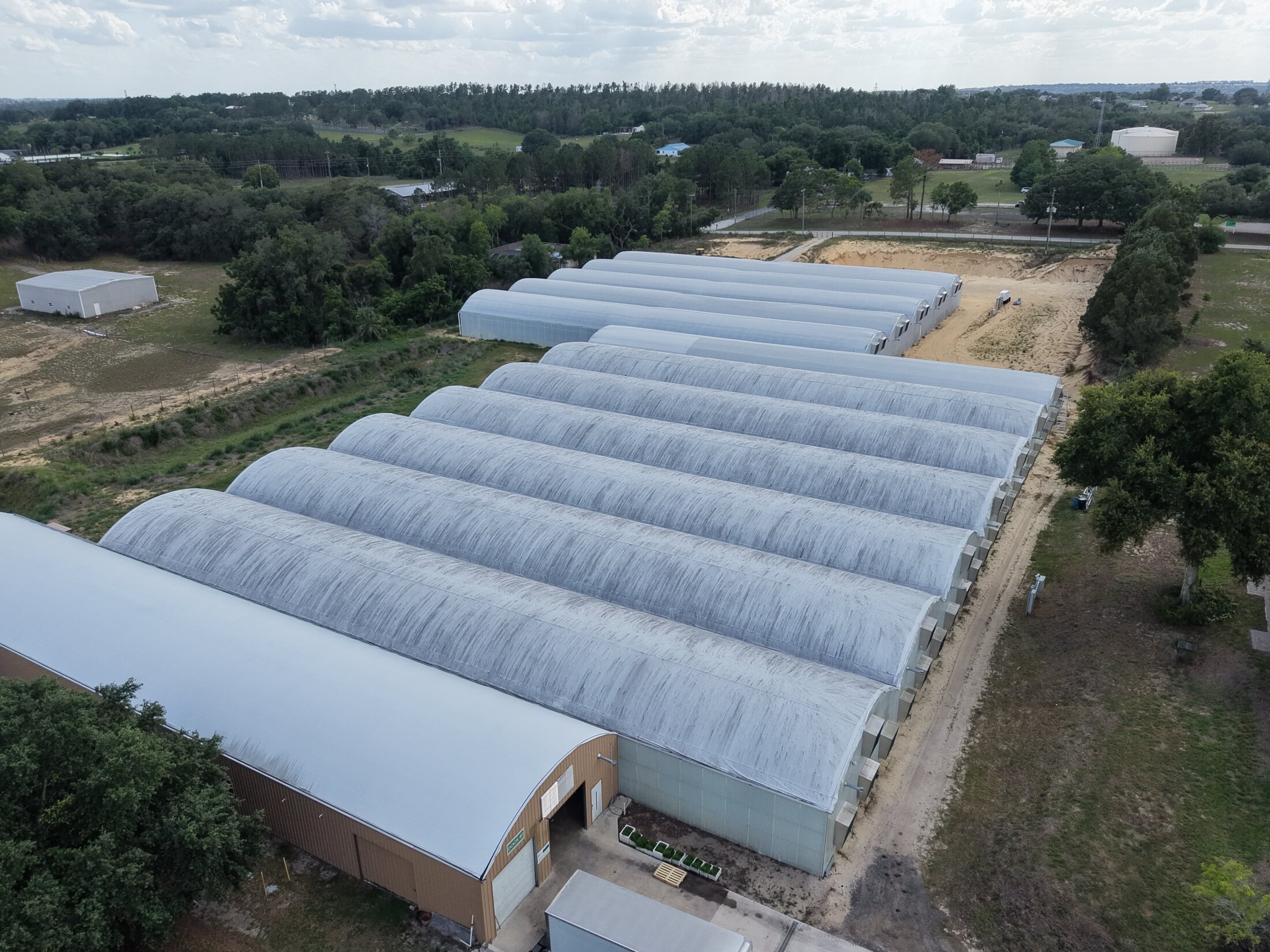
We built Florida Fresh Events so we could answer them. Because we design the floral, grow the plants, build the props, and own the inventory, those decisions belong to us rather than to a subcontractor.
Certified growing, independently verified
Our greenhouse operations are MPS and CA certified — outside validation of how we manage water, fertilizer, crop protection, energy, and waste. It is not a standard we grade ourselves against.
We grow more of what we use
Trees, tropicals, palms, and foliage are grown and maintained on our own property in Central Florida, refreshed between events and used again rather than trucked in from a distant supplier and discarded afterward.
Owned inventory, reused
Containers, furniture, scenic elements, props, backdrops, and structures are built to be repainted, reconfigured, and rented again. A single piece can carry dozens of events, spreading its footprint across all of them.
Reducing floral foam
Chicken wire, pin frogs, reusable grids, water-based mechanics, moss and natural materials, and foam-free structural systems. Heat, travel time, and event duration still set real limits, so we describe this as meaningful reduction rather than claiming to be foam free.
Composting organic waste
Flowers, foliage, branches, leaves, and soil are separated where practical and returned to productive use. The lifecycle of an arrangement should not have to end when the event does.
Responsible floral sourcing
We continue increasing purchases from farms certified through Florverde Sustainable Flowers, Rainforest Alliance, and comparable programs. Not every variety or season can be sourced that way — and we will tell you which ones can.
900 pongamia seedlings, and a five-acre goal
Pongamia is a hardy, oil-seed-bearing tree well suited to Florida conditions, and it sequesters carbon as it matures. We’ve planted the seeds and are now growing more than 900 seedlings toward our first five-acre planting site, targeted for late 2027 — a carbon project we’re building ourselves and can drive you out to see, rather than a credit purchased from a marketplace.
These are planning estimates from published pongamia research, not our own audited numbers. We’ll report our actual acreage, yield, and verified carbon as the grove matures. Read the full story.
Beyond Florida: conservation and carbon projects
We support a small number of specific places rather than buying a generic offset label. We chose each one, and we can tell you why.
- Peru · Amazon. Forest protection that keeps intact ecosystems standing — carbon storage, biodiversity, watershed protection, and local employment.
- Jama-Coaque Ecological Reserve, Ecuador. Tropical forest restoration and habitat connectivity in one of the most biologically important, and most threatened, regions on earth.
- Indigenous communities, including the Waorani. You cannot separate a forest from the people who live in it. We do not treat these communities as marketing material and we do not cast ourselves as the solution — we listen, build long-term relationships, and support the work those communities identify as meaningful.
Our leadership conducts field missions to these projects — meeting the people doing the work, examining how the money is actually used, and deciding whether the program deserves continued support. That is why we can speak to this work rather than forward you a brochure.
What you can actually document
We would not tell you that an event is sustainable because you hired us, and you should not repeat it — that is exactly the kind of claim that falls apart under a follow-up question.
What we can give you, on any event we produce, is a 25-point evaluation report showing the carbon produced and offset on your behalf. That is a document you can put in a proposal, an RFP response, or a post-event recap, backed by our records rather than a good-faith promise. It matters at the moment your client, your board, or your procurement team asks how you know.
Why we can speak to this
Our founder has spent 30 years working in sustainability, across floriculture, solar, and organic farming. Over that career he has helped convert more than 15,000 acres of floral and produce ground to organic and sustainable growing methods. Converting land is slow, unglamorous, and expensive — and it is the only version of this work that changes anything.
He previously served as CEO of a San Francisco–based magazine and eco-boutique that was an early pioneer of the organic and sustainable lifestyle market, a decade spent judging other companies' sustainability claims from the buyer's side of the table.
Frequently asked questions
What is the most sustainable option for event florals?
Generally, locally grown and reusable living plant material, combined with foam-free mechanics and certified cut flowers where the variety and season allow. There is no single answer, because seasonality, transport time, heat, and venue restrictions all constrain what is possible on a given event.
Can an event be carbon neutral?
An event's emissions can be estimated and then offset, which is what most "carbon neutral event" claims describe. That is different from having reduced the emissions in the first place. We prefer to document what was produced and what was offset, and let the client decide how to characterize it.
Is floral foam bad for the environment?
Traditional floral foam is generally a petroleum-based, single-use product that can break down into small particles. Reusable alternatives exist and we use them wherever the design and engineering allow, but heat, transport, and event duration still make foam necessary in some applications.
What does MPS certification mean for flowers and plants?
MPS is an international horticultural certification covering environmental performance in growing operations — including water, fertilizer, crop-protection practices, energy consumption, and waste management, with recordkeeping requirements behind it. It applies to the growing operation, not to an individual stem.
How do I write the sustainability section of an event RFP?
Ask for specifics rather than commitments: which certifications, covering what scope, what percentage of material is owned versus bought new, what happens to organic waste, and what documentation the vendor can provide afterward. Vendors who are doing the work will welcome the questions.
Let us brief your team
No pitch deck, no sales presentation. Robert will come to your office, your sales meeting, or your client planning session and walk your team through what is really being asked, what is defensible to promise, and where the traps are — including every term on this page and whichever ones your clients are using.
Book a sessionOr read the full program on our sustainability page.